

Chatbot Roast
Three Months of Looking at Service Websites Broke Me
June 20, 2026 · 7 min read
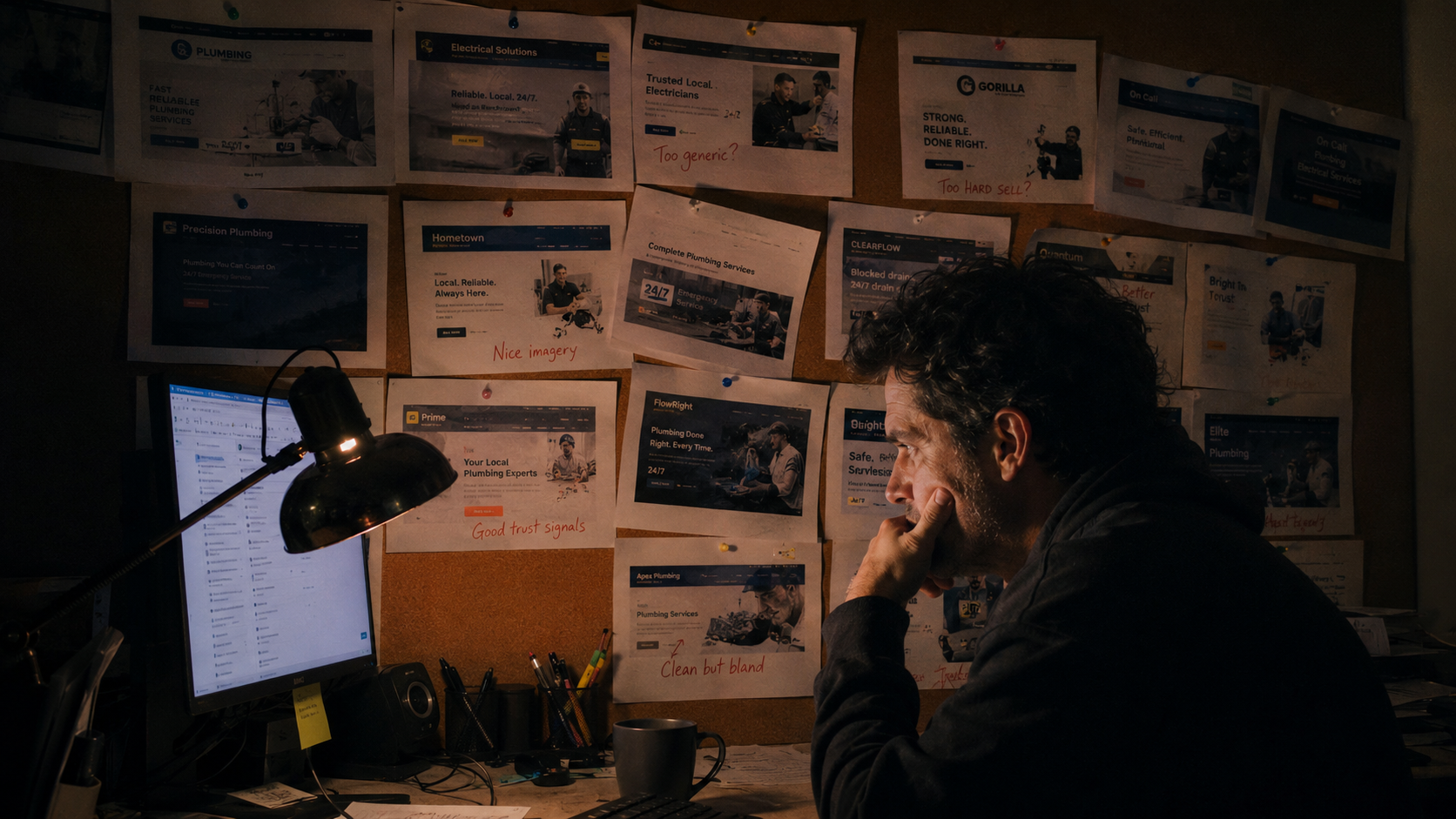
46% of people call. 3% fill out the form. We built everything for the 3%.
Three months. Over a hundred service business websites. Plumbers, cleaners, electricians, landscapers, pest control, HVAC.
Same pattern every time. Beautiful design. Professional photography. Trust badges. Five-star reviews.
And a conversion path that treats the customer like an inconvenience.
I'm going to say what the web design industry won't: your website is a brochure, not a salesperson. And the chatbot you added made it worse.
The number that should end every meeting
46% vs 3%
phone leads vs. form submissions
When a service business gets a lead, 46% of those leads come through the phone. Not the form. Not the chatbot. The phone.
The contact form? 3%. Three percent.
That means 97% of your website visitors who want to hire you are NOT filling out your form. They're calling, leaving, or bouncing to a competitor.
And yet every website I audited was designed form-first. Big "Get a Quote" button. Multi-field submission. "We'll get back to you in 24–48 hours."
You built the entire conversion path for the 3% and wondered why revenue didn't move.
Then they added a chatbot
The agency's answer to low form conversion? "Add a chatbot!"
So now the website has a form nobody fills out AND a chatbot nobody wants to talk to.
The chatbot pops up in 2 seconds. Interrupts the visitor reading about emergency services. Offers three buttons. None of them book an appointment.
"Get a quote" routes to the same form. "Talk to someone" puts them in a queue. "Browse FAQ" sends them to a page they didn't ask for.
You took a 3% conversion path and added a friction layer on top of it. That's not innovation. That's doubling down on failure.
What 100 websites taught me
Your website shouldn't inform visitors. It should talk to them.
The sites that convert don't look the most modern. They don't have the fanciest animations. They don't have chatbot bubbles.
They talk. A voice on the homepage — not in the corner, not behind a widget — that says "Tell me what you need and let's get you booked."
The visitor speaks. The agent asks two questions. Quotes a range. Books a slot. Done.
No form. No "we'll get back to you." No decision tree pretending to be AI.
The website behaves like the best receptionist you've ever hired — except it works at 9pm on Thursday and never calls in sick.
The chatbot didn't fail. The model failed.
85%
who don't get an answer will never call back
I'm not anti-technology. I'm anti-pretending.
Chatbots pretend to be conversation. Forms pretend to be convenient. Contact pages pretend to be a conversion strategy.
Meanwhile, 46% of your leads are trying to call you — and half those calls go unanswered because you're a service business, not a call center.
The model is broken. Not the execution. The model.
You don't need a better chatbot. You need a website that does what your best employee does: answer the phone, understand the job, and close the booking.
Three months. One conclusion.
Every service business I audited had the same gap: a beautiful website that couldn't have a conversation.
They spent $5,000 to $15,000 on design. $49/month on a chatbot. $500/month on Google ads to send people to a site that can't close.
The fix isn't another widget. It's making the website talk.
Not a chatbot in the corner. A voice in the hero. Available now. Trained on your business. Booking jobs while you sleep.
Three months of data. One conclusion: stop building brochures. Start building salespeople.
Hear your homepage talk back.
Drop your URL for a personalized demo — about 10 minutes.
Keep reading
Chatbot Roast
The Web Design Industry Stole Ten Years From Service Businesses
For ten years, the web design industry sold service businesses a billboard and called it a salesperson.

Chatbot Roast
Every Chatbot Claim vs. What Actually Happens
Your chatbot vendor sent you a deck full of promises. Here's what your customers actually experience.

Chatbot Roast
The Chatbot Industry Is a $10 Billion Lie
The chatbot industry is worth $10 billion. Not because chatbots work. Because the lies are well-marketed.